
news
One clear set of rules: the Spamhaus Sender Guidelines
In this News Article
Jump to
Introduction
One question we get asked more than any other is: "What do I need to do to stay off Spamhaus blocklists?"
The answer hasn’t changed over the past 20 years. Only send email to people who have asked for it and make sure your sending infrastructure is set up properly. Most listings are caused by the same recurring, but avoidable, mistakes.
The guidance to help has always been available, but it’s been spread across FAQs, best practice blogs, and support tickets. So, we've brought it all together in one place: the Spamhaus Sender Guidelines. Read on to find what’s covered and what you need to do next. We hope it makes life a little easier for senders everywhere!
Who are these guidelines for?
Anyone who runs a mail server, from IT admins and small businesses managing their own set up to large senders and Email Service Providers (ESPs).
What’s covered
These guidelines are split into six areas - plus a bonus ESP page - detailing, requirements, recommendations, and practices you need to avoid:
- Minimum requirements: This is your must do checklist to avoid being listed. Senders, mail admins, and postmasters, if you do nothing else, make sure you meet these.
- Infrastructure and DNS: These are the basics every sending server needs, including valid reverse DNS, a HELO hostname that resolves correctly, and properly configured From domains.
- Permission and list hygiene: Lack of permission is one of the two most common reasons we make a listing. Get confirmed opt-in before sending bulk email, and keep clean lists to avoid hitting spam traps.
- Authentication: SPF, DKIM, and DMARC, prove your email is really yours, and when properly configured, protect your domain from spoofing and phishing.
- Sending best practices: ‘How’ you send is just as important as ‘what’ you send. Warm up new IPs and domains, manage bounces, and provide an easy way to unsubscribe.
- IP and domain reputation: We look at multiple signals before assigning a reputation score to your IP or domain. Be proactive and check them regularly using the IP and domain reputation checker tools, instead of waiting for an issue to happen first.
And for the bonus page…
ESPs and large senders: If you’re responsible for mail sent via your infrastructure, what your customers send, impacts your own reputation. Use this dedicated page for guidance on how to implement the Spamhaus Sender Guidelines at scale.
Check your HELO and DNS Infrastructure
DNS is kind of our thing. It’s also the other most common reason for listings, usually because of an invalid HELO, no reverse DNS (PTR) record, or no matching A record. And a poorly configured server can easily be mistaken for a compromised one or a spammer.
To avoid this, the guidelines also come with a tool to check your DNS setup. All you need to do is enter your sending IP, click “Check HELO/DNS.” The tool inspects your setup against the Sender Guidelines and identifies areas that need to be resolved. Due to internal policies, results are not available for all IPs and may not reflect recent changes.
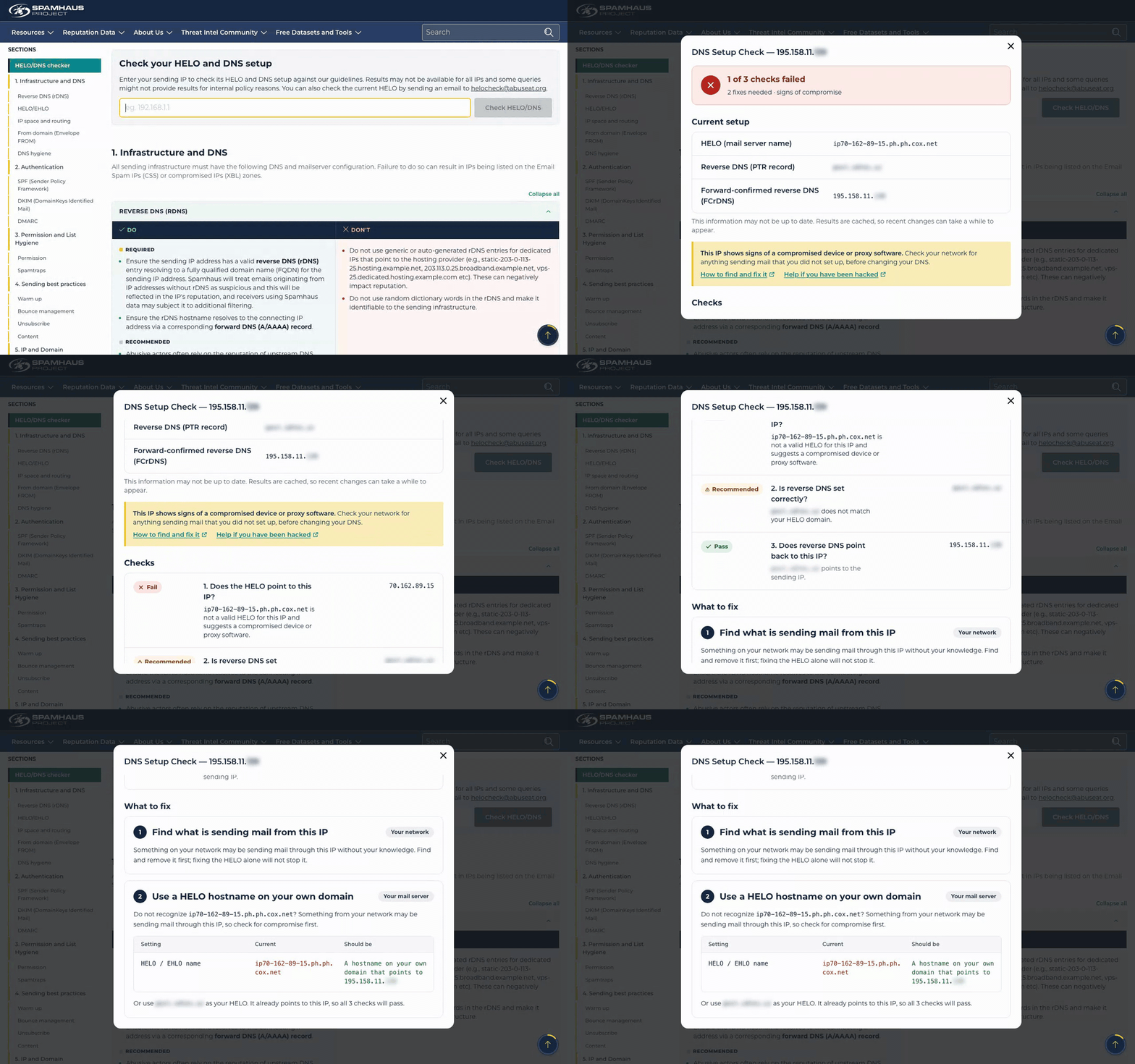
Already listed? The same troubleshooting guidance is provided via the IP and Domain Reputation Checker at: https://check.spamhaus.org/
What you should do next
Starting in November 2026, we’re gradually rolling out enforcement of basic DNS requirements over several months. Spamhaus will require a valid HELO, a reverse DNS (PTR) record, and a matching A record for every sending IP.
If you send email, now is the time to check your DNS setup:
- Read the Spamhaus Sender Guidelines and ensure you are meeting the key requirements.
- If listed, run your configuration through our HELO checker tool, and investigate anything that doesn’t pass.
- Check your IP reputation and domain reputation.
Where these guidelines are based on
These guidelines aren’t new rules. They’ve always existed through RFCs (IETF technical standards, including those that define how email works), mailbox providers’ best practices, and what responsible senders already do.
What’s been missing is a single, independent view. These Sender Guidelines are aligned with existing guidance from mailbox providers, with additional emphasis on DNS and infrastructure. For several decades, Spamhaus has helped protect billions of mailboxes from spam and other threats, and our guidelines are built to apply wherever your mail is sent.
A big thank you to Laura Atkins, Jennifer Nespola Lantz and Matthew Vernhout for their time, expertise, and honest feedback.